How to Stay PCI Compliant: A Practical Guide for Small Businesses
Understanding PCI compliance is one thing. Knowing what your business needs to do to meet its requirements is another.
If you accept credit or debit card payments, you’re responsible for maintaining a secure payment environment and meeting the PCI DSS requirements that apply to your business.
The good news? For many small businesses, the process can be manageable with the right payment technologies, security practices, and guidance.
This practical guide explains how to assess your responsibilities, complete your compliance validation, and maintain security throughout the year.
What Does PCI Compliance Mean for Your Business?
PCI compliance isn’t the same for every business.
Your responsibilities depend on how you accept payments, the technology you use, and whether your systems store, process, or transmit cardholder information.
Here’s what different types of businesses should pay particular attention to:
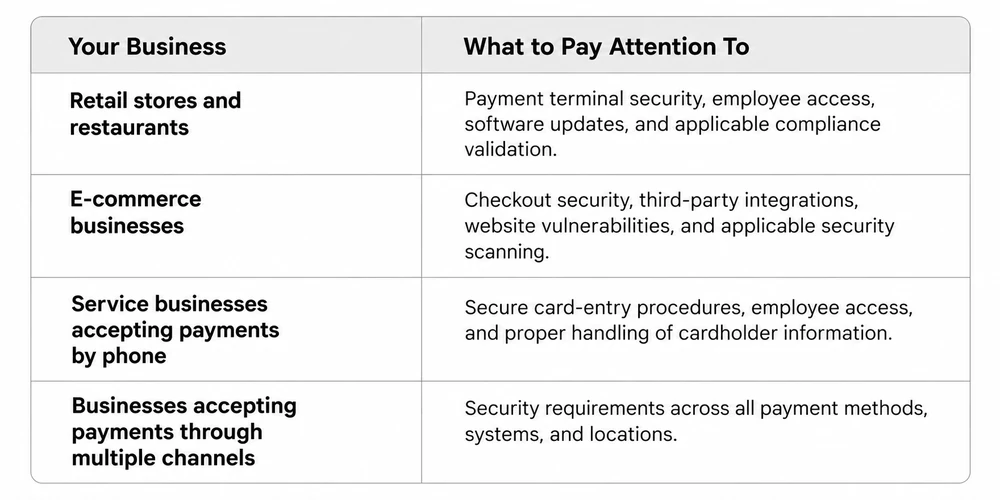
These examples highlight common responsibilities. Your actual PCI DSS requirements depend on your payment environment.
What If You Use a Third-Party Payment Provider?
Using a PCI DSS-compliant payment provider can significantly simplify your compliance responsibilities by reducing the amount of sensitive payment information your business handles.
However, it doesn’t automatically make your business PCI compliant.
For example, you may still need to protect your payment terminals, secure your website, restrict employee access, and complete applicable compliance validation.
The important thing is to understand which security responsibilities your payment provider handles and which remain with your business.
Your PCI Compliance Checklist
Not sure where to start? Use this checklist to review your business’s payment security practices.
- Identify how you accept payments. In-store, online, over the phone, or through multiple channels.
- Confirm your compliance requirements. Ask your payment provider which PCI DSS requirements and validation method apply to your business.
- Review your third-party providers. Confirm which security responsibilities your payment providers handle and which remain with your business.
- Secure your payment systems. Keep software updated, use strong passwords, enable multifactor authentication where required, and restrict access to authorized employees.
- Protect cardholder information. Avoid storing cardholder data unnecessarily and never store sensitive authentication data after authorization.
- Complete your compliance validation. Submit your annual Self-Assessment Questionnaire (SAQ) or other required documentation, as applicable.
- Perform required security scans. Depending on your payment environment, quarterly external vulnerability scans or other security testing may be required.
- Review your security regularly. Reassess your practices whenever you introduce new equipment, software, or payment methods.
Not sure which requirements apply to your business? PandaPay can help you navigate the process.
What Is a Self-Assessment Questionnaire (SAQ)?
A Self-Assessment Questionnaire, or SAQ, is a PCI DSS validation tool that allows eligible businesses to evaluate and report whether they meet applicable security requirements.
Think of it as a structured review of how your business protects payment information.
There are different types of SAQs, depending on how your business accepts and handles card payments.
For example:
- SAQ A: May apply to eligible merchants that fully outsource applicable account-data processing to PCI DSS-compliant third-party providers.
- SAQ B-IP: May apply to eligible merchants using standalone, IP-connected, PCI-approved payment terminals under specified conditions.
- SAQ C-VT: May apply to eligible merchants manually entering payments through a third-party, web-based virtual terminal under specified conditions.
- SAQ D: Covers merchants that are not eligible for another merchant SAQ type.
Not every business is eligible to use an SAQ. Some merchants must undergo a more comprehensive assessment.
Your acquiring bank or payment provider can help determine which validation method applies to your business.
How Do You Complete Your Annual PCI Compliance Validation?
For many small businesses, PCI compliance validation follows five main steps.
Step 1 — Review Your Payment Environment
Start by identifying how your business accepts card payments.
Do you use payment terminals? Accept payments over the phone? Operate an online store? Use several payment methods?
Review any changes since your last assessment, including new equipment, software, integrations, or payment channels.
These changes may affect your PCI DSS requirements.
Step 2 — Complete Your Security Assessment
If your business is eligible, complete the Self-Assessment Questionnaire (SAQ) that applies to your payment environment.
The questionnaire helps you evaluate whether the required security controls are in place.
Answer each question accurately and address any identified gaps rather than simply checking boxes.
Step 3 — Complete Any Additional Security Checks
Depending on your payment environment, you may need to complete additional security testing.
This can include external vulnerability scans conducted by an Approved Scanning Vendor (ASV), penetration testing, or other applicable security assessments.
Where quarterly ASV scanning is required, it must generally be performed at least once every three months, with additional scans after significant changes as applicable.
Step 4 — Submit Your Compliance Validation
Once you’ve completed the required assessment and security checks, submit the appropriate documentation.
Depending on your validation method, this may include:
- Your completed Self-Assessment Questionnaire (SAQ).
- An Attestation of Compliance (AOC).
- Applicable vulnerability scan reports.
- Other documentation requested by your acquiring bank or payment processor.
Keep copies of your documentation and track any outstanding security issues.
Step 5 — Maintain Your Security Practices
Completing your annual validation doesn’t mean your responsibilities end.
Continue monitoring your payment environment, updating systems, managing employee access, and addressing vulnerabilities.
PCI compliance is an ongoing responsibility, not a once-a-year exercise.
How Do You Maintain PCI Compliance Throughout the Year?
Your business and its security risks can change over time.
New employees, software updates, payment technologies, and online integrations can introduce vulnerabilities that weren’t present during your last assessment.
Maintaining PCI compliance requires regular attention to three important areas:
- Your systems and technology. Keep payment software, devices, and relevant systems updated and secure.
- Your people and processes. Review access permissions, train employees on payment security, and maintain appropriate procedures.
- Your security controls. Perform required monitoring, testing, and reviews to identify potential weaknesses.
A useful practice is to review your payment security whenever you make a significant operational or technological change.
When Should You Review Your PCI Compliance?
In addition to your regular security activities and annual validation, review your compliance responsibilities when you:
- Introduce a new payment terminal or POS system.
- Launch an online store or change your checkout provider.
- Add a new payment channel.
- Integrate new software with your payment systems.
- Open a new location.
- Make significant changes to your network or payment infrastructure.
These changes don’t necessarily require a new annual assessment immediately, but they may affect your security controls, compliance scope, or testing obligations.
What If You Only Sell Online?
If you operate exclusively online, your compliance responsibilities depend largely on how your checkout processes payments.
For example, using a hosted checkout from a PCI DSS-compliant provider can reduce the amount of sensitive cardholder information your website handles.
However, your website may still affect the security of the payment process.
Depending on your checkout configuration, you may need to:
- Keep your e-commerce platform and plugins updated.
- Protect your website against unauthorized changes.
- Secure administrative accounts.
- Verify your payment provider’s PCI DSS compliance.
- Complete applicable security assessments and vulnerability scans.
Under PCI DSS v4.0.1, eligible SAQ A e-commerce merchants may also be required to undergo quarterly external vulnerability scanning, even when payment processing is outsourced.
The key takeaway: Using a secure e-commerce platform simplifies PCI compliance, but doesn’t automatically eliminate your obligations.
Why Is PCI Compliance Billed Quarterly?
Some payment providers, including PandaPay where applicable, offer quarterly billing for PCI compliance-related services.
This billing arrangement is separate from PCI DSS requirements. The PCI Security Standards Council does not require merchants to pay a universal quarterly compliance fee.
Depending on your service agreement, quarterly billing can provide:
- Predictable expenses. Spread the cost of compliance-related services throughout the year.
- Ongoing support. Access assistance with compliance-related questions when included in your agreement.
- Continuous attention to security. Keep compliance on your business agenda beyond annual validation.
Your fees and the services included depend on your agreement with your payment provider.
How Does PandaPay Help You Stay PCI Compliant?
Managing PCI compliance can feel like another administrative responsibility on an already busy schedule.
PandaPay helps merchants understand their payment security obligations and navigate the applicable compliance process.
From secure payment technologies to guidance and support, our goal is to make managing payment security simpler, so you can focus on running your business.
Whether you’re opening your first store, expanding online, or managing several payment channels, understanding your responsibilities is an important first step.
The Bottom Line
Staying PCI compliant isn’t about completing a questionnaire once a year. It’s about maintaining a secure payment environment every day.
Start by understanding how your business accepts payments, identifying the requirements that apply to you, and following essential security practices.
With regular reviews, appropriate payment technologies, and the right support, PCI compliance can become a manageable part of your business operations.
And with PandaPay, you don’t have to navigate it alone.
New to PCI compliance? Read our companion article, What Is PCI Compliance and Why Does It Matter for Your Business?, to understand the fundamentals.