Understanding Credit Card Processing Rates and Fees: What Every Small Business Should Know
Every time a customer taps, inserts, or enters a credit card, your business pays a price for accepting that payment.
It may seem insignificant. A few cents here, a percentage there. But over hundreds or thousands of transactions, those costs can add up to thousands of dollars a year.
For small businesses operating on tight margins, understanding payment processing fees isn’t just an accounting exercise. It’s an opportunity to protect profitability.
Yet many merchants don’t really know what they’re paying for.
They see a processing rate on their statement, perhaps a monthly service fee, and assume that’s simply the cost of accepting credit cards.
The reality is more complicated. Not all fees are created equal, not all pricing models work the same way, and the lowest advertised rate doesn’t necessarily mean the lowest processing cost.
Understanding how payment processing fees work is the first step toward making sure your business isn’t paying more than it should.
What Are Credit Card Processing Fees?
When a customer pays by credit card, several organizations work behind the scenes to authorize, process, and settle the transaction.
Each plays a different role, and the cost of processing that payment is generally divided into three main components.
1. Interchange Fees
Interchange fees typically represent the largest portion of credit card processing costs.
These fees are generally paid to the financial institution that issued the customer’s card, such as a bank.
The applicable rates are established through the payment card networks, including Visa and Mastercard, and vary depending on several factors:
- The type of card used, such as a standard, rewards, or premium credit card.
- Whether the payment is made in person or online.
- The type of business accepting the payment.
- The transaction’s characteristics and applicable interchange category.
For example, accepting a premium rewards credit card may cost more than accepting a standard credit card.
Interchange rates can also change over time, affecting the underlying cost of accepting payments.
2. Assessment and Network Fees
Assessment fees are charged by payment card networks, such as Visa and Mastercard, for using their payment infrastructure.
These fees help support the networks that facilitate electronic transactions.
Depending on the card network and transaction, additional network-related charges may apply.
Unlike the processor’s markup, interchange and network fees are generally established by the payment card networks rather than negotiated individually by merchants.
3. Payment Processor Fees
Payment processors provide the technology, infrastructure, and services that allow businesses to accept electronic payments.
In exchange, they charge fees for processing transactions and delivering related services.
These may include:
- A percentage-based processing markup.
- A fixed fee per transaction.
- Monthly account or platform fees.
- Payment terminal or equipment charges.
- Other services included in the merchant agreement.
This is where pricing can vary significantly between payment providers.
While interchange and network fees establish much of the underlying cost, the processor’s pricing structure determines how those costs are passed on to your business.
Why Do Some Credit Card Transactions Cost More Than Others?
Imagine two customers each spend $100 at your store.
The first pays with a standard credit card. The second uses a premium rewards card.
The purchase amount is identical, but the cost of processing those transactions may be different.
Why?
Because interchange rates can vary by card type, transaction method, and other characteristics.
An online transaction may also have a different interchange cost than an in-person transaction.
This is why comparing payment processing offers based on a single advertised percentage can be misleading.
What matters isn’t simply the rate you’re quoted. It’s the total cost of processing the payments your business actually accepts.
Understanding the Three Most Common Pricing Models
Payment providers generally use different approaches to determine how much merchants pay.
Three common models are flat-rate pricing, tiered pricing, and cost-plus pricing.
Each works differently, and understanding those differences can help you make a more informed decision.
1. Flat-Rate Pricing: Simple, but Not Always the Most Economical
Flat-rate pricing charges merchants a predetermined rate for transactions within a defined category.
For example, a provider might charge 2.9% plus $0.10 per transaction.
The advantage is simplicity. You know the published rate for that transaction category, regardless of the underlying interchange cost.
For a small business just getting started, that predictability can be appealing.
However, flat-rate pricing has an important limitation.
If the actual interchange cost of a transaction is lower than the rate built into the provider’s pricing, the merchant doesn’t automatically benefit from that difference.
As transaction volume increases, the difference between a flat rate and the actual underlying processing cost can become more significant.
Best suited for: Businesses that prioritize simplicity, particularly those with lower or less predictable transaction volumes.
2. Tiered Pricing: Different Rates, Different Categories
Tiered pricing, sometimes called bundled pricing, groups transactions into different pricing categories.
These are commonly described as:
- Qualified transactions: Transactions that meet the processor’s criteria for the lowest pricing tier.
- Mid-qualified transactions: Transactions assigned to an intermediate pricing tier.
- Non-qualified transactions: Transactions assigned to a higher-cost pricing tier.
The challenge is that these categories are generally defined by the payment processor.
A transaction may be assigned to a more expensive tier because of the card type, the way the payment was accepted, or other processing criteria.
For example, a merchant might be quoted an attractive qualified rate, only to discover that a significant percentage of actual transactions falls into more expensive categories.
This can make it difficult to understand exactly how much of the fee represents the underlying card cost and how much represents the processor’s margin.
The potential downside: A low advertised qualified rate doesn’t guarantee low overall processing costs.
3. Cost-Plus Pricing: Greater Transparency Into What You Pay
Cost-plus pricing, also known as interchange-plus pricing, separates the underlying card acceptance costs from the payment processor’s markup.
Instead of combining everything into a single rate, the merchant pays:
Interchange + applicable network fees + processor markup
The processor’s markup is clearly defined in the merchant agreement.
It may be expressed as a percentage, a fixed amount per transaction, or a combination of both.
For example, a provider might charge interchange and applicable network fees, plus a processing markup of 0.30%.
The merchant can distinguish between the underlying payment costs and the additional amount charged by the processor.
This makes it easier to understand where the money goes and compare competing offers.
The main advantage of cost-plus pricing is transparency.
Rather than relying on broad pricing categories, merchants can see how underlying transaction costs and the processor’s markup contribute to their fees.
What Does Cost-Plus Pricing Look Like in Practice?
Let’s compare the cost of processing a $100 credit card transaction under two hypothetical pricing models.
These examples are illustrative and don’t represent actual PandaPay rates or current interchange schedules.
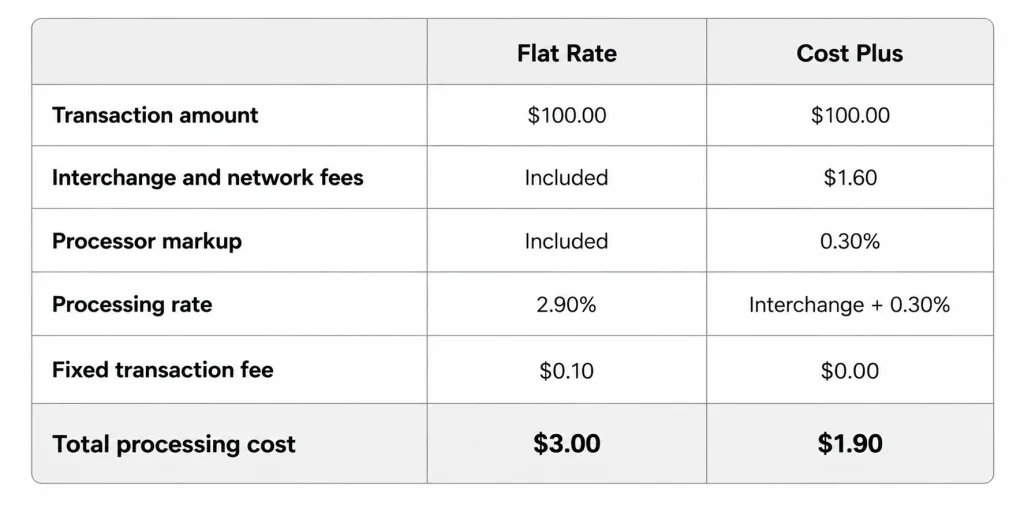
In this example, cost-plus pricing saves the merchant $1.10 on a single $100 transaction.
Now imagine that business processes $50,000 in card payments each month, with a similar transaction mix and an average transaction value of $100.
The difference could represent approximately $550 in monthly savings, or $6,600 annually.
Of course, actual results depend on card types, transaction methods, interchange rates, network fees, processor markups, and other applicable charges.
The point isn’t that cost-plus pricing always costs less.
It’s that understanding how your fees are calculated makes it easier to determine whether you’re getting a competitive deal. For many growing businesses, cost-plus pricing is worth evaluating because it separates the processor’s markup from the underlying card costs. However, transparency alone doesn’t guarantee the lowest total price. A provider with a high markup or additional fees may still cost more than a competitive flat-rate alternative.
What Happens When Interchange Rates Change?
Interchange rates aren’t necessarily fixed forever.
Payment card networks periodically review and update their interchange schedules.
These changes can increase or decrease the underlying cost of certain transactions.
How those changes affect your business depends partly on your pricing model.
With cost-plus pricing, changes in interchange generally flow through to the merchant.
If the applicable interchange rate decreases, the cost of that transaction decreases, assuming other charges remain unchanged.
If interchange increases, the cost rises accordingly.
With flat-rate or tiered pricing, the merchant’s rate doesn’t necessarily change when underlying interchange rates move.
That means a reduction in interchange costs may not automatically translate into lower processing fees.
This doesn’t mean every flat-rate or tiered provider retains every interchange saving. Pricing policies and agreements vary.
But it highlights an important advantage of transparent pricing: you can see how changes in underlying payment costs affect what your business pays.
How to Read Your Payment Processing Statement
Your merchant statement contains valuable information about what your business pays to accept cards.
But you need to know where to look.
Start with these five questions.
1. What Is My Total Processing Cost?
Look beyond the advertised rate.
Add up all processing-related fees charged during the statement period, including applicable transaction, network, account, and service fees.
2. What Is My Effective Processing Rate?
Your effective rate shows what you’re actually paying relative to your total card payment volume.
The formula is simple:
Effective processing rate = Total processing fees ÷ Total card sales × 100
For example, if your business processes $40,000 in card sales and pays $1,000 in processing fees:
$1,000 ÷ $40,000 × 100 = 2.5%
Your effective rate is 2.5%.
This is often a more useful starting point than comparing advertised rates.
However, effective rates should be compared over similar periods and transaction mixes, with the same categories of fees included.
3. How Much Am I Paying in Processor Markup?
If you’re on cost-plus pricing, look for the distinction between interchange, network fees, and processor charges.
If you’re on tiered pricing, ask your provider to explain how transactions are classified and how the pricing is calculated.
4. What Additional Fees Am I Paying?
Look for recurring or occasional charges such as:
- Monthly account or platform fees.
- Payment terminal rental or service fees.
- Chargeback fees.
- PCI compliance-related service fees.
- Gateway or virtual terminal fees.
- Other administrative or service charges.
Not every fee is unnecessary. Some cover legitimate services.
The important thing is to understand what you’re paying for and whether those services provide value to your business.
5. Have My Fees Changed?
Compare several statements rather than reviewing only one month.
Look for changes in effective rates, transaction fees, interchange categories, and additional charges.
If something has increased, ask your payment provider why.
Five Ways to Reduce Your Payment Processing Costs
Understanding your fees is important. Acting on that information is where the real value begins.
Here are five practical ways to take greater control of your payment costs.
1. Review your effective rate regularly. Don’t rely exclusively on the advertised processing rate. Monitor what your business actually pays each month.
2. Compare total costs, not just percentages. Consider processor markups, transaction fees, equipment, software, and other services when evaluating offers.
3. Understand your transaction mix. Your average purchase amount, card types, and proportion of online versus in-person payments can significantly influence your costs.
4. Ask about interchange-plus pricing. A transparent pricing structure can make it easier to identify your provider’s markup and understand changes in processing costs.
5. Review your agreement. Understand which fees apply, how rates may change, and what services are included before committing to a provider.
The goal isn’t simply to negotiate the lowest advertised percentage.
It’s to find the payment solution that delivers the best overall value for your business.
How PandaPay Helps You Protect Your Margins
At PandaPay, we believe merchants deserve to understand what they’re paying for.
That’s why we emphasize competitive transaction rates, clear pricing, and no hidden fees.
Our approach goes beyond processing payments. We help businesses choose payment and commerce solutions that support their operations while keeping costs under control.
Whether you’re opening your first store, expanding online, or managing multiple locations, our team can help you evaluate your payment needs and identify opportunities to improve efficiency and protect your margins.
Because every dollar you save on unnecessary processing costs is a dollar that stays in your business.
The Bottom Line: Know What You’re Paying For
Credit card processing fees are a necessary part of doing business. Paying more than you need to isn’t.
Interchange fees, network assessments, processor markups, flat rates, and tiered pricing can make payment costs seem complicated.
But once you understand how these charges work, you can ask better questions, compare offers more effectively, and make more informed decisions.
For small businesses, that knowledge can translate into meaningful savings.
The most important rate isn’t the one advertised. It’s the one you actually pay.
And understanding the difference is one of the simplest ways to start protecting your margins.